
Introduction
Multidisciplinary Team (MDT) meetings have become an essential part of modern healthcare, enabling specialists from different departments to collaborate, review complex cases, and develop comprehensive treatment strategies.
In today’s clinical environment, medical images are at the center of these discussions. CT, MRI, PET, pathology images, and other diagnostic data need to be presented clearly and accurately to support effective communication and decision-making.
However, many MDT rooms still rely on commercial TVs, projectors, or general-purpose displays originally designed for entertainment or business presentations. While these solutions may appear sufficient for displaying images, they are not designed to meet the specific requirements of medical image review.
This creates several challenges that can impact the efficiency and reliability of MDT collaboration.
The Hidden Challenges of Traditional MDT Display Solutions
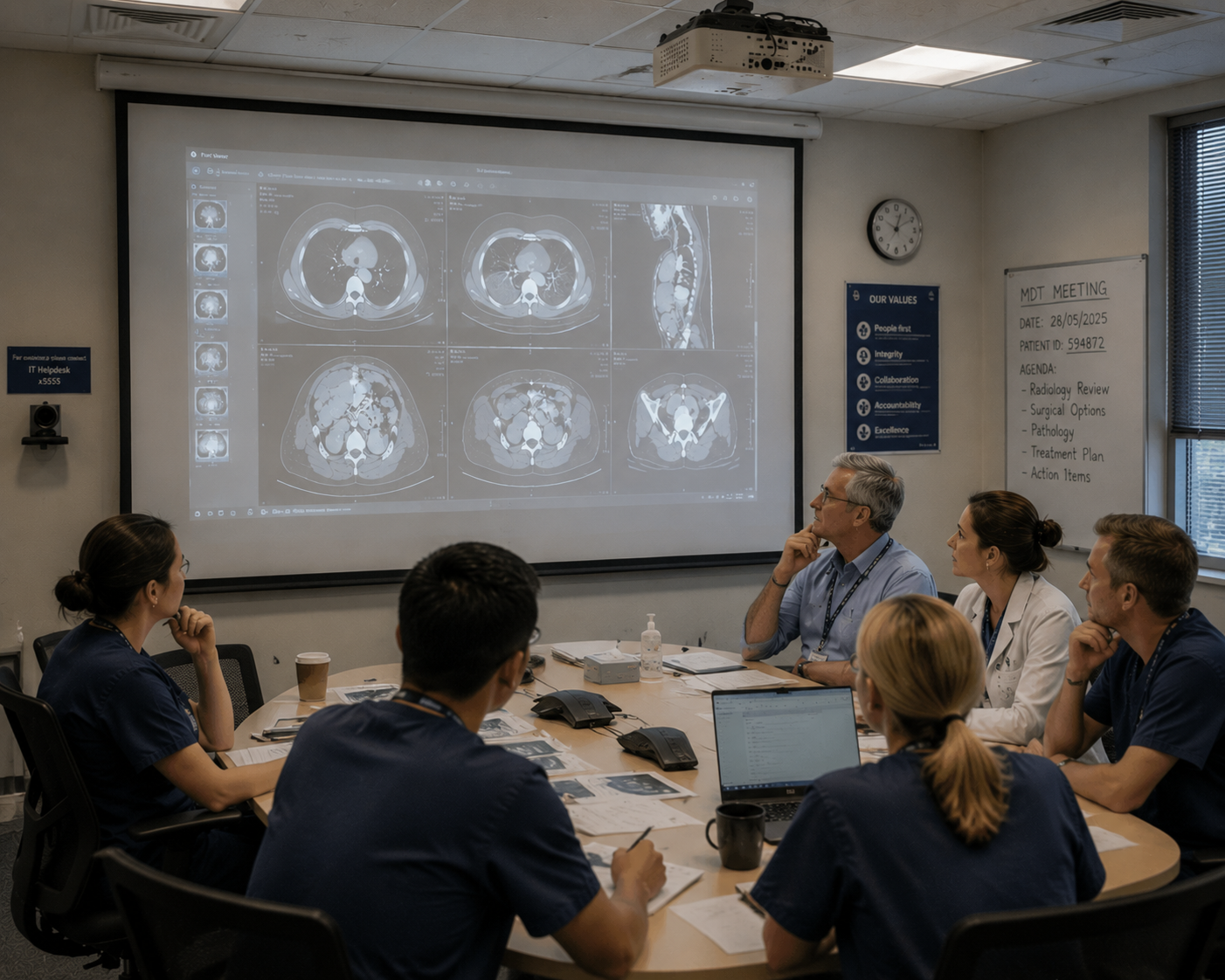
A typical MDT room using a projector, and medical images are usually washed out. Impossible for diagnosis purpose.
1. Lack of DICOM Calibration: Inconsistent Medical Image Presentation
Medical imaging requires precise grayscale reproduction to ensure subtle differences in image intensity can be accurately visualized.
However, standard consumer displays typically do not support DICOM calibration, the medical imaging standard used to maintain consistent grayscale performance.
Without proper calibration:
Image brightness and contrast may differ from the original diagnostic data
Fine details may become difficult to distinguish
Different displays may present the same image differently
Clinicians may not have confidence that the displayed image represents the intended information
For MDT discussions, where multiple specialists rely on shared image interpretation, consistent image quality is critical.
2. Lack of Quality Assurance (QA): Difficult to Maintain Long-Term Performance
Display performance naturally changes over time due to hardware aging and environmental factors.
Traditional TVs and projectors generally lack professional QA mechanisms, making it difficult to continuously monitor:
Brightness stability
Grayscale accuracy
Display consistency
Without regular quality monitoring, a display that looks acceptable today may gradually deviate from its original performance, affecting the reliability of clinical image review.
A medical MDT display should not only provide excellent image quality at installation — it should maintain that quality throughout its service life.
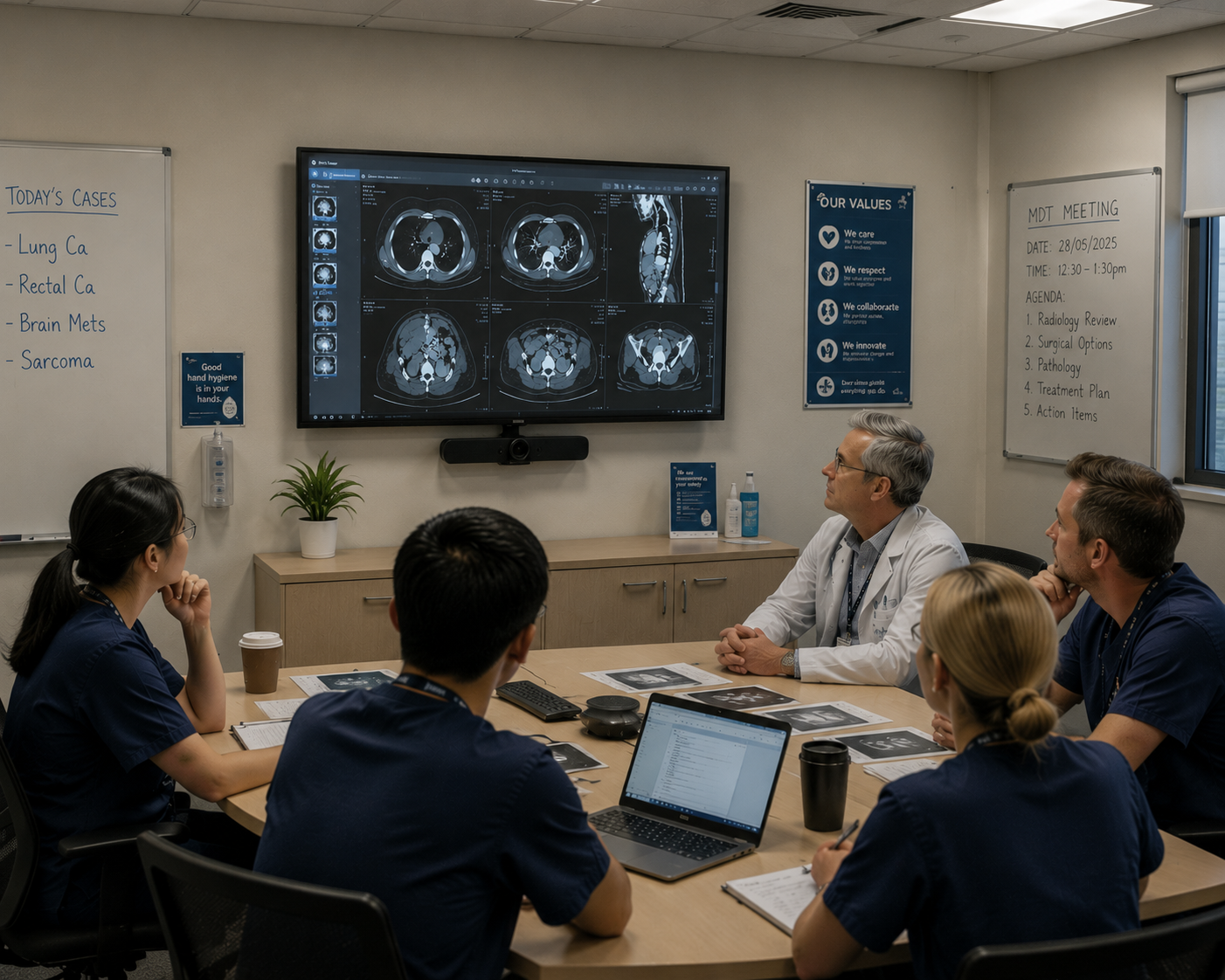
A typical MDT room using a TV, usually with smaller size, plus no DICOM calibration and QA for long-term assurance.
3. Limited Interaction: Designed for Presentation, Not Collaboration
Traditional display solutions are mainly designed for passive viewing.
During MDT discussions, clinicians often need to:
Navigate through multiple cases
Compare different image sources
Zoom and review specific areas
Annotate or interact directly with images
Switch between different systems quickly
A conventional TV or projector cannot efficiently support these interactive workflows, creating unnecessary delays during clinical discussions.
4. Poor Adaptability to Complex MDT Environments
Modern MDT rooms often involve multiple systems and participants:
PACS/RIS systems
Surgical planning platforms
Pathology images
AI-assisted diagnostic tools
Video conferencing systems
A suitable MDT display solution must support multiple inputs, flexible layouts, and seamless collaboration between different clinical applications.
JUSHA S9820A / S8610A: A Purpose-Built Solution for Modern MDT Collaboration
To address these challenges, JUSHA developed the S9820A 98-inch and S8610A 86-inch 8MP MDT Diagnostic Monitor, a medical-grade display designed specifically for multidisciplinary clinical collaboration. S9820A.pdfPDF
Unlike consumer displays, Jusha MDT solution combines diagnostic image performance with intelligent workflow capabilities, helping healthcare teams achieve more efficient and reliable MDT discussions.
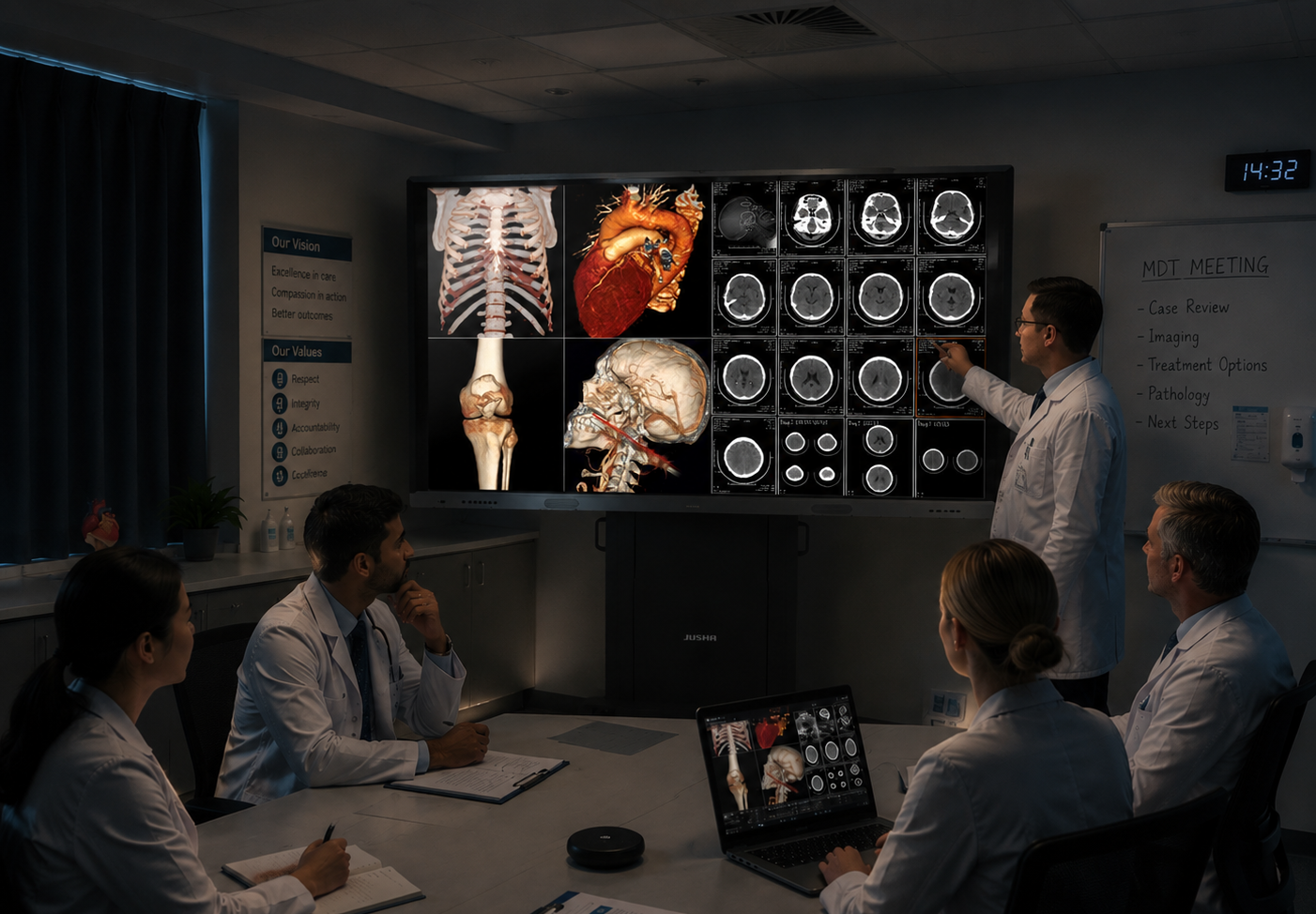
Jusha MDT solution, fully meeting diagnosis standards with DICOM calibration and QA. Together with touch screen, protective glass, incredible sizes, OPS, KVM, CGA, and plenty of features for better usability, productivity, and reliability.
Key Advantages
1. Medical-Grade Image Quality with DICOM Calibration
The S9820A delivers:
98-inch large-format display
8MP resolution
DICOM calibration capability
16-bit LUT technology
These technologies help ensure accurate grayscale reproduction and consistent image presentation, supporting clearer medical image review during MDT meetings.
2. Integrated QA and Sensor Technology
The S9820A integrates QA functionality and sensors directly into the display system.
This enables:
Automated quality monitoring
Long-term image consistency management
Easier maintenance of display performance
Healthcare organizations can reduce dependence on external calibration processes while improving confidence in display reliability.
3. Interactive Touch Collaboration
MDT meetings are not just about viewing images — they are about discussion and collaboration.
The S9820A supports multi-touch interaction, allowing clinicians to directly engage with displayed content, improving communication efficiency and creating a more intuitive review experience.
4. Optimized Workflow for Complex Clinical Environments
The S9820A supports advanced workflow features, including:
Multi-window display for multiple image sources
Dual OPS functionality
KVM switching
USB-C connectivity
Ambient light sensing
These features allow healthcare teams to connect different systems and manage clinical information more efficiently in one integrated workspace.
The Future of MDT Collaboration Requires More Than a Bigger Screen
An MDT room is not simply a meeting space with a large display. It is a clinical decision-making environment where image accuracy, workflow efficiency, and collaboration quality directly influence patient care.
Replacing consumer-grade displays with medical-grade MDT solutions represents an important step toward:
More reliable image communication
More efficient multidisciplinary collaboration
Better clinical decision support
The JUSHA S9820A is designed with one goal in mind:
To transform MDT visualization from simple image display into intelligent clinical collaboration.